


As a Salesforce outsourcing company, you might consider that ForteNext will be biased towards this model, but in reality it’s a two-way cost/benefit relationship - finding the right partner is critical for both BPO (Business Process Outsourcer) and client, as both will need to dedicate significant attention, trust, and resources to ensure it’s a profitable relationship.
The answer depends on far more than cost. It hinges on speed, scale, access to expertise, and where Salesforce sits within your broader business strategy.
If your CRM, eCommerce platform, customer service software, or marketing automation are critical to your business’s ability to acquire and retain customers profitably then utilizing a specialist to ensure you can maximize ROI from your third-party software is critical.
To help you determine whether you should insource, outsource or adopt a hybrid approach we will detail the outsourcing landscape, define Salesforce outsourcing, compare it with in-house management, and provide a practical framework to help you decide.
IT outsourcing (a broader term is BPO) is the practice of engaging third-party providers to deliver technology services that might otherwise be handled internally.
These services range from application development and infrastructure management to CRM platforms like Salesforce, integrations, analytics, and ongoing support.
In the US, IT implementation and ongoing management is predicted to nearly double in size over the next 5 years, into a trillion-dollar industry.
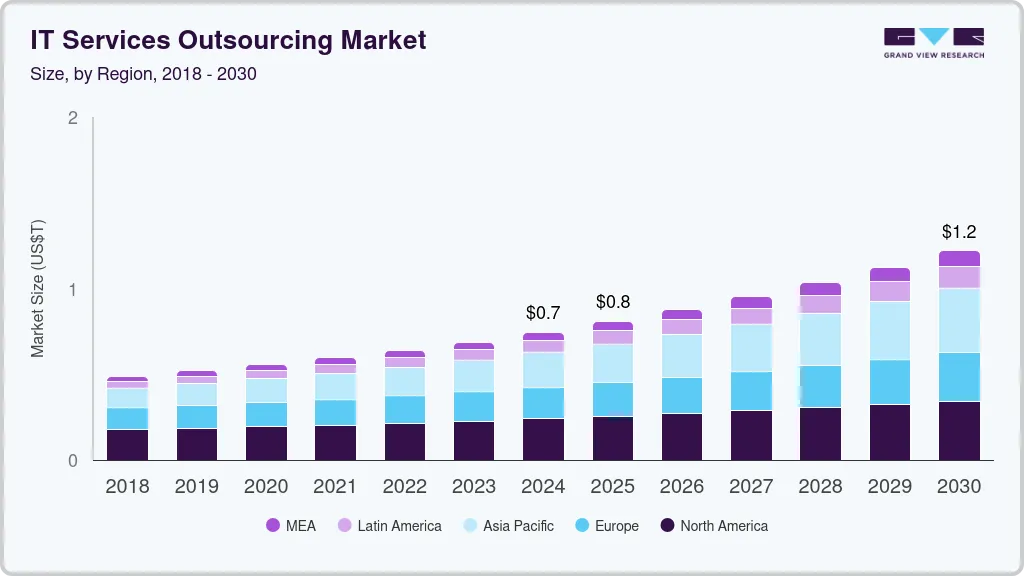
Grand View Research predicts this growth is down to sustained digital transformation, cloud migration, cybersecurity demands, and persistent talent shortages. As a result, organizations will increasingly rely on specialist partners rather than building every capability internally.
This growth is not simply a byproduct of overall market expansion. Outsourcing is becoming more structurally embedded in operating models.
Many organisations now view outsourcing as a strategic lever rather than a tactical cost-saving exercise. Instead of outsourcing entire functions, companies selectively outsource areas where depth of expertise, speed of execution, or scalability matter most.
This shift has led to greater adoption of varied delivery models. In Salesforce specifically, organisations typically choose between onshore, nearshore, and offshore outsourcing. Each offers different trade-offs across cost, collaboration, time zones, and access to talent. The right model depends less on geography and more on how well the delivery approach aligns with business urgency, governance requirements, and internal maturity.
Also known as subcontracting, this involves delegating some or all Salesforce responsibilities, such as implementation, custom development, administration, integrations, and ongoing optimisation to a specialist external partner.
This approach has gained traction because Salesforce is no longer a single application. It is a broad ecosystem of clouds, platforms, and industry-tailored products, each requiring distinct skills. Managing this complexity internally often demands a large, highly specialised team, something many organisations struggle to build and sustain.
Sales Cloud and Service Cloud require continuous optimisation as sales processes evolve and customer expectations increase. Commerce Cloud introduces enterprise-grade eCommerce complexity, blending front-end experiences with order management, integrations, and performance optimisation.
Marketing Cloud and Account Engagement (Pardot) demand specialist expertise in automation, segmentation, and analytics to deliver measurable ROI. MuleSoft adds another layer of complexity, connecting Salesforce to ERPs, data platforms, and third-party systems. Newer offerings like Agentforce and industry clouds further expand the platform’s scope.
For many organisations, outsourcing Salesforce is not about relinquishing ownership - it’s about ensuring these products are managed by teams that work with them at scale, every day.
According to Salesforce Ben, demand for Salesforce specialist talent has returned to positive territory with 8% global growth year-over-year, though this recovery masks significant imbalances across roles that will impact how organizations approach implementation.
The most acute shortage exists for technical and solution architects, where demand surged 27% and 21% respectively while supply increased only 4% for technical architects, creating a critical bottleneck for firms in manufacturing, retail, healthcare, fintech, and higher education seeking to implement complex, integrated Salesforce environments.
With consultant demand growing 14% globally and representing 25% of all job listings, alongside a 25% expansion in the consulting partner ecosystem to over 3,700 firms, organizations facing architectural talent scarcity are increasingly pressured to outsource implementation and managed services rather than build internal teams.
This pressure is particularly acute given that administrators - traditionally easier to hire internally, saw supply surge 47% while demand grew only 14%, and developer demand actually declined 12% globally, likely due to AI automation.
For enterprises in regulated industries like healthcare and fintech, or those managing complex operations like manufacturers and retailers, the shortage of high-level architectural expertise combined with the expanding availability of specialized consulting partners makes outsourcing not just attractive but potentially necessary to successfully navigate today's multi-cloud, AI-integrated Salesforce implementations while avoiding technical debt.
Salesforce outsourcing is often driven by a combination of speed, capability, and focus. Specialist partners bring platform depth that would take years to replicate internally, allowing businesses to move faster while reducing delivery risk.
Cost also plays a role, but not always in the way organisations expect. While outsourced work can appear more expensive on a per-hour basis, it frequently leads to better overall cost control. Businesses avoid fixed overheads such as full-time salaries, benefits, ongoing training, and certification costs, instead paying only for the services they actively use.
Furthermore, specialists have exposure across multiple industries and these learnings can absolve the client from the capital and time-intensive resource deployment, accelerating their time to break-even point from their outsourcing.
Outsourcing can deliver powerful advantages, particularly for organisations that prioritise speed, flexibility, and access to specialist expertise without committing to long-term internal overhead.
One of the most tangible benefits of outsourcing Salesforce is accelerated time to value. Specialist partners bring pre-built frameworks, reusable components, and deep platform experience that allow projects to move faster and with fewer false starts. Rather than designing everything from scratch, experienced teams apply proven patterns refined across multiple implementations.
This advantage is especially evident in Salesforce Commerce Cloud projects, where architecture, integrations, and performance optimisation can otherwise decelerate delivery.
At BioStem Technologies, Salesforce Commerce was revamped to streamline commerce processes and enhance performance. By working with a specialist Salesforce partner, the organisation achieved results faster than initially forecasted, avoiding delays commonly associated with building internal delivery capability mid-project.
Similarly, Procure Impact leveraged outsourced Salesforce expertise to rapidly deploy B2B Commerce Cloud in support of its social impact marketplace. The engagement demonstrated how a dedicated delivery team can significantly shorten implementation timelines while maintaining scalability and quality.
Where available, specific metrics such as reduced launch timelines, faster order processing, or improved operational KPIs should be drawn directly from the case studies to quantify this impact.
Salesforce’s ecosystem is in a constant state of flux, with frequent releases and expanding cloud capabilities. Outsourcing provides immediate access to certified specialists across multiple Salesforce products - from Commerce and Service Cloud to Marketing Cloud, MuleSoft, and emerging platforms like Agentforce.
Outsourcing also gives organizations easier access without geographic or time zone constraints - working with overseas specialists can also help open up new markets thanks to familiarity with regulations in different regions.
This depth of expertise reduces delivery risk, improves solution quality, and enables organisations to adopt new Salesforce capabilities faster than internal teams often can.
Outsourced Salesforce teams can scale up or down as demand reminders change. This is particularly valuable for organisations with variable workloads, seasonal peaks, or project-based needs.
Instead of hiring ahead of demand or carrying excess capacity, businesses gain the ability to adjust resourcing dynamically. Reaping this reward hinges on the effectiveness of collaboration tools between client and vendor.
Rather than absorbing fixed costs such as salaries, benefits, training, and certification renewals, outsourcing allows organisations to align Salesforce spend directly with usage. This creates greater financial predictability and clearer ROI measurement.
Net Benefit from Salesforce Outsourcing =
Benefits of Outsourcing Across 30 KPIs
minus
Total Costs of Outsourcing
minus
Value foregone by not Insourcing
Established Salesforce service providers bring mature delivery frameworks, quality controls, security practices, and governance models. This helps mitigate risks related to compliance, data protection, and delivery consistency - especially in complex or regulated environments.
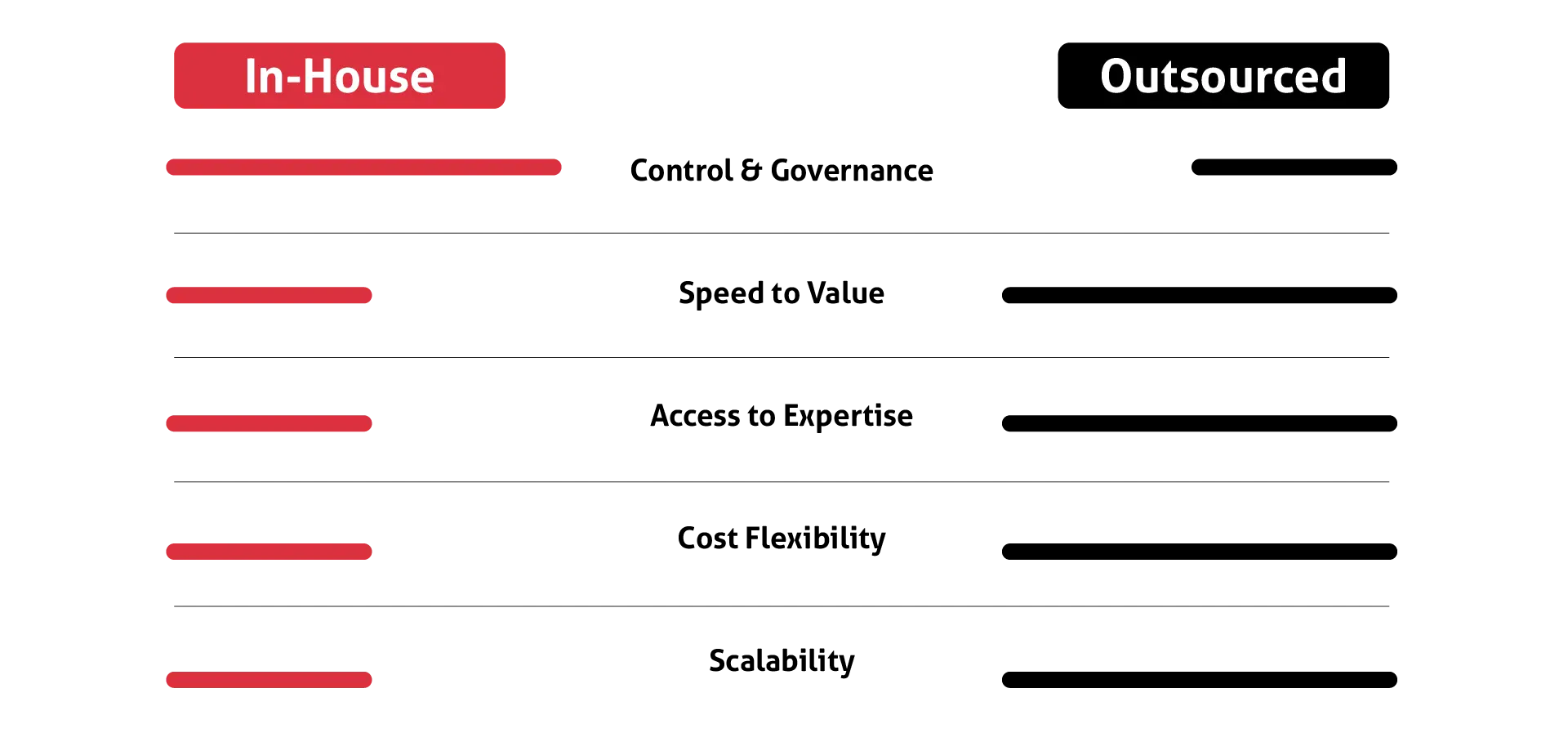
Managing Salesforce in-house remains the right choice for some organisations, particularly where Salesforce is deeply embedded in daily operations and demand is consistent.
Internal teams benefit from deep organisational knowledge. They understand internal processes, business context, and stakeholder dynamics in ways external partners need time to learn. For organisations with stable requirements and long-term Salesforce roadmaps, in-house teams can deliver strong value over time.
However, this approach requires sustained investment. Salesforce skills must be continuously updated, certifications maintained, and talent retained in a highly competitive market.
While in-house teams may deliver lower per-unit costs for steady workloads, they often struggle to scale quickly or support highly specialised initiatives without external assistance. Leveraging global staff augmentation can help fill skills gaps for firms even with deeply-embedded Salesforce talent.
The real distinction between outsourcing and in-house delivery is not simply cost - it is opportunity cost.
When Salesforce delivery is handled internally, highly skilled staff are often focused on configuration, maintenance, or backlog delivery. This can limit their ability to contribute to higher-value strategic initiatives. Outsourcing shifts much of that execution burden away from internal teams, allowing them to focus on innovation and business alignment.
Outsourcing introduces contracts, SLAs, and vendor management requirements. In-house teams, however, bring their own operational overhead, including recruitment cycles, HR administration, training budgets, and organisational red tape. Neither model is friction-free; the key question is which set of trade-offs best aligns with your organisation’s priorities.
If a client outsources, insources, or adopts a hybrid approach, in these 3 different universes, what will be the organization's revenue, customer acquisition, retention, CSAT and NPS, company value and other metrics such as employee satisfaction?

Outsourcing can fail without strong governance. Poorly defined scope, weak communication, or misaligned expectations can erode value. Successful outsourcing requires treating partners as extensions of your team, with clear accountability and shared objectives.
In-house teams face different risks. Skill gaps can emerge as Salesforce evolves faster than teams can upskill. Attrition can expose organisations to knowledge loss if expertise is concentrated in a few individuals. Over time, internal teams may become reactive rather than proactive without external perspective.
To determine whether outsourcing is the right imperative, consider the following questions:
If most answers point toward speed, flexibility, and specialisation, outsourcing, or a hybrid model, is likely the better fit. If stability, direct control, and consistent workload dominate, in-house management may be the right foundation.
There is no universal answer to whether Salesforce should be outsourced or managed in-house. The most effective organisations align their delivery model with their business goals, internal capabilities, and growth trajectory.
Outsourcing excels when speed, specialist expertise, and scalability matter most. In-house teams shine when Salesforce is a long-term operational constant with predictable demand. Increasingly, the optimal approach is hybrid - retaining strategic ownership internally while outsourcing specialised delivery, complex implementations, or ongoing managed services.

Simon Wright is a B2B demand generation and content strategist with 10+ years' experience across enterprise and ecommerce. He brings a dual perspective; navigating the complexity of B2B and the pace of D2C, to help ambitious organisations turn marketing into a measurable growth engine.





