


This shift is not simply a technical trend. Headless Commerce gives enterprises the ability to innovate faster, design more freely, integrate more effectively, and scale with fewer constraints.
In this article we explore the top ten benefits of adopting a headless architecture for Salesforce Commerce and why this model represents the future of digital commerce.
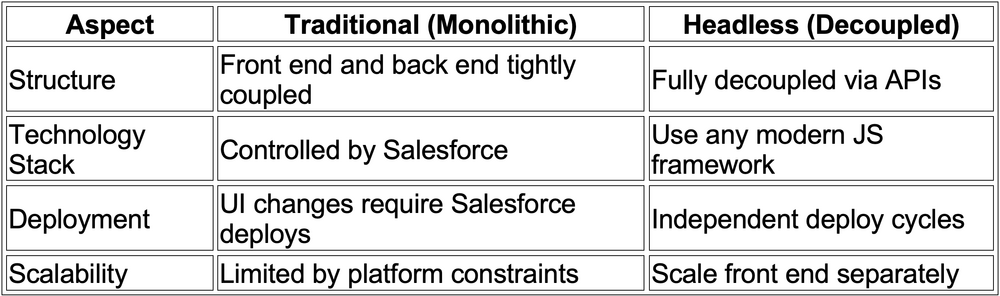
One of the most significant advantages of a Headless approach is the ability to decouple the front end from the back end. In a monolithic setup, the user interface, business logic, and data layers are tightly integrated inside Salesforce. This restricts front end development to what the platform supports.
With headless, the front end becomes fully independent. It can be built using technologies like React, Next.js, Vue, or Angular, while Salesforce provides data and transaction logic through APIs. This gives development teams greater control, enabling rapid iteration and experimentation without touching back-end systems.
Thanks to increased consumerization of B2B storefronts, user experience is often the deciding factor for customer engagement and conversion. Salesforce Headless Commerce offers complete design freedom because the front end is no longer limited by Salesforce templates, page layouts, or legacy rendering constraints.
Companies can build high-performance, visually refined interfaces that reflect their brand identity and meet the expectations of modern buyers. Headless front ends can also use server-side rendering or static site generation to deliver fast load times and improved SEO performance.
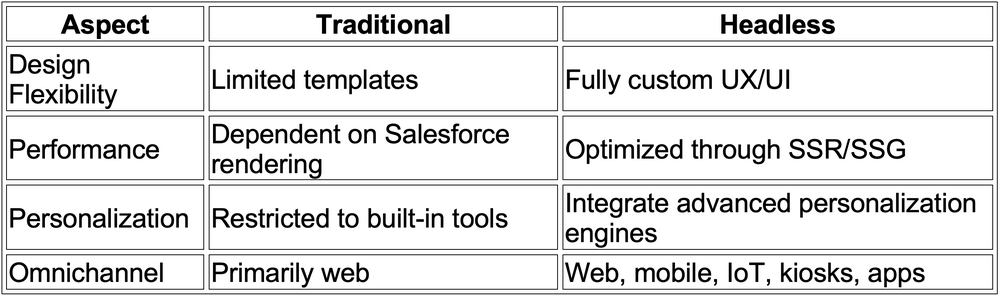
Page speed is both an SEO ranking factor and a conversion driver. Traditional Salesforce storefronts rely on server-side rendering and platform-tied rendering processes that can introduce latency, especially in B2B environments with large catalogs and complex pricing rules.
A headless approach allows teams to apply modern performance techniques. Static site generation, prefetching, CDN-level caching, and edge rendering can dramatically increase speed. Front ends can be tuned independently to handle high traffic volumes, seasonal spikes, or large data loads without overloading the Salesforce instance.
SEO benefits significantly as well, since search engines prioritize sites with quick time-to-first-byte and responsive client interactions.
Modern buyers interact with brands across multiple channels. Salesforce Headless Commerce supports omnichannel strategies by allowing a single Salesforce back end to power front ends across web, mobile, IoT, kiosks, dealer portals, partner apps, and even social commerce connectors.
This ensures that catalog data, pricing structures, entitlements, and inventory remain consistent across every channel. Instead of building multiple disconnected experiences, businesses maintain one centralized system that supports many touchpoints.
The result is a unified buyer journey regardless of where the interaction begins or ends.
Enterprises rely on multiple systems including ERPs, PIMs, CRMs, OMS platforms and analytics engines. Traditional commerce architectures often restrict how these systems can connect. A headless architecture solves this through an API-first model.
Salesforce offers GraphQL APIs, REST APIs, Experience APIs, and MuleSoft connectors that enable real-time data exchange. A headless front end can blend Salesforce data with data from PIMs, custom services, or external APIs without being limited by Salesforce's rendering or page structure.
This leads to smoother integrations, cleaner data flows, and the ability to add or replace systems without replatforming the entire commerce ecosystem.
One of the most practical benefits of Salesforce Headless Commerce is team independence. With a monolithic system, front-end developers must coordinate with back-end developers for every release. This slows down experimentation, testing, and feature development.
Headless eliminates this dependency. Front-end teams can ship new interfaces, features and optimizations without requiring a Salesforce deployment. Back-end teams can enhance logic, workflows, and integrations without impacting the storefront.
This reduces risk and increases the velocity of innovation. Businesses can deploy microsites, run A/B tests, and release UX improvements at a pace aligned with customer expectations rather than platform constraints.
Composable commerce is becoming the dominant model across enterprise digital systems. Salesforce Headless Commerce fits perfectly into this approach because it allows organizations to choose best-in-class technologies for different areas of the commerce stack.
Search engines, personalization systems, CMS platforms, AI-driven recommendation engines, and analytics tools can all be integrated seamlessly. Salesforce remains the operational engine, while the front-end layer becomes a flexible orchestration environment.
This future-proofs the business by reducing dependency on any single vendor and enabling rapid adaptation as technologies evolve.
A decoupled front end ensures that branding stays consistent across every digital interface. Instead of forcing the brand into predefined Salesforce templates, teams can build cohesive experiences tailored to specific audiences, industries, or regions.
This consistency strengthens trust and improves brand perception. For companies with multiple storefronts, partner portals, or global divisions, headless architecture ensures alignment without duplicating business logic.
While Salesforce Headless Commerce can require more initial investment, it reduces long-term costs by minimizing platform constraints and avoiding expensive redesigns or replatforming efforts.
Traditional setups accumulate technical debt because UI customizations are tied to platform limitations. With headless, the front end evolves independently. Redesigns, new channels, and major UX upgrades do not require altering Salesforce code or undoing past customizations.
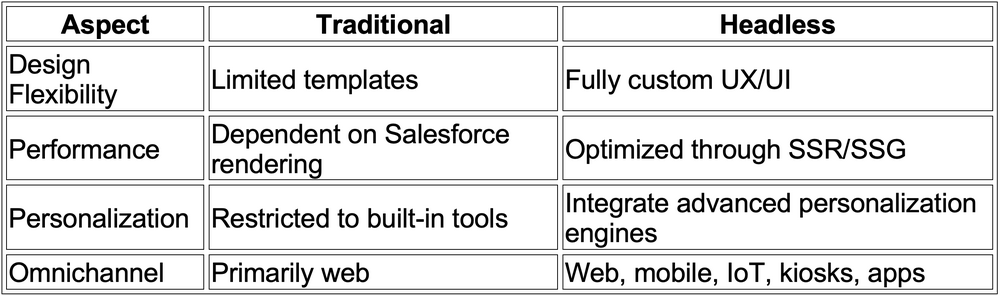
In industries where most competitors use similar platforms, differentiation comes from the experience, not the technology itself. Salesforce Headless Commerce empowers companies to design digital experiences that are distinct, fast, personalized and purpose-built for a best-in-class customer journey.
Competitors cannot copy these experiences overnight because they are driven by architecture, not just design. This makes headless a strategic advantage that compounds over time.
Headless empowers organizations to innovate faster, design more freely, deliver omnichannel experiences, integrate complex ecosystems, and reduce long-term operational costs. Most importantly, it enables companies to build differentiated digital experiences that grow with customer expectations and market demands.

Simon Wright is a B2B demand generation and content strategist with 10+ years' experience across enterprise and ecommerce. He brings a dual perspective; navigating the complexity of B2B and the pace of D2C, to help ambitious organisations turn marketing into a measurable growth engine.





