


That excuse no longer holds.
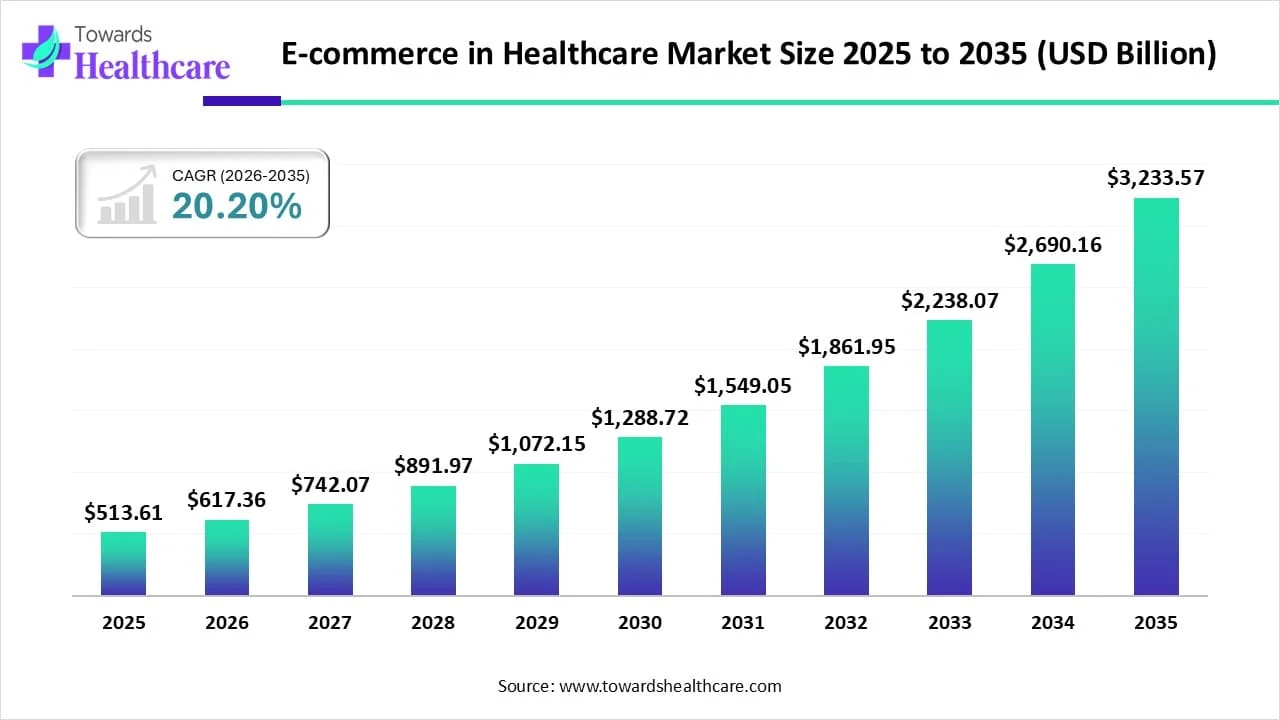
The global healthcare e-commerce market is projected to grow from roughly $513 billion in 2025 to more than $3.2 trillion by 2035. That growth isn’t coming from novelty consumer apps alone. It’s coming from hospitals modernizing procurement, medical device companies shifting to recurring revenue, and biotech firms replacing manual ordering processes that were never designed to scale.
The uncomfortable truth is this: commerce in healthcare was never simple – we just avoided fixing it.
Now it’s being rebuilt properly.
B2B Is Where the Real Complexity – And the Real Value – Lives
Despite the noise around direct-to-consumer healthcare, the real transformation is happening quietly in B2B. Hospitals, labs, research institutions, and provider networks are demanding the same things every enterprise buyer demands in other industries: transparency, predictability, and self-service.
What makes healthcare different is not the demand – it’s the constraints. Pricing is negotiated. Products are regulated. Buyers are credentialed. Orders are recurring but rarely identical. And a single transaction often represents a long-term service relationship.
This is why traditional e-commerce platforms struggle here. They were built for catalogs and carts, not contracts and compliance.
Salesforce Commerce Cloud works in this environment precisely because it does not try to abstract away complexity. It allows organizations to model it. Account-based pricing, entitlement-driven catalogs, role-aware access, and deep CRM integration are not edge cases in healthcare – they are the baseline.
Ovation Medical’s transformation is a case in point. Before modernizing, order processing was fragmented and slow, heavily dependent on manual intervention. By rebuilding their ordering experience on Salesforce B2B Commerce, Ovation didn’t just speed up transactions. They reduced operational risk, improved data quality, and created a system that could grow without adding headcount, while removing friction from systems that were never designed for today’s scale.
One of the most persistent mistakes healthcare organizations make is treating commerce as a front-end concern. A website refresh. A portal launch. A digital initiative owned by marketing.
That mindset collapses the moment real buyers arrive.
Healthcare commerce touches pricing engines, ERP systems, service workflows, inventory, compliance, and analytics. If those systems are not aligned, no amount of UX polish will save the experience.
This is where software consulting earns its keep. Not by installing platforms, but by forcing hard architectural conversations early. What is the source of truth for pricing? Where do entitlements live? How do we enforce compliance without killing usability? How do orders flow cleanly from click to fulfillment?
When commerce is treated as infrastructure rather than a channel, these questions become unavoidable – and solvable.
Direct-to-consumer healthcare still represents a smaller share of total value than B2B, but its influence is outsized. Patients ordering diagnostics kits, clinicians buying directly from suppliers, and administrators managing subscriptions all bring consumer-grade expectations with them.
They expect clarity. Speed. Feedback. They expect systems that work.
BioStem Technologies’ Salesforce Commerce implementation demonstrates this shift. By modernizing their commerce processes, BioStem delivered a buying experience that felt intuitive and modern without sacrificing the account-based controls required in a regulated environment. Orders flowed cleanly into NetSuite. Shipping visibility improved. Sales teams stopped acting as human middleware.
The lesson here isn’t that healthcare should become retail. It’s that usability is no longer optional, even in B2B.
Why App Development, DevOps, and Data Matter More Than the Platform
Platforms get the attention. Engineering foundations determine the outcome.
In healthcare, custom application development is often the difference between theoretical capability and real-world adoption. Guided device configuration, credential verification, post-purchase service workflows, and training enablement rarely exist out of the box. They must be built – carefully.
DevOps, meanwhile, is not about velocity for its own sake. In healthcare commerce, reliability is the feature. Automated testing, controlled releases, and observability are what allow teams to ship improvements without risking downtime that could disrupt clinical operations.
And none of it works without data engineering. Commerce data that doesn’t flow cleanly into analytics, forecasting, and reporting systems is just noise. When data pipelines are designed intentionally, commerce becomes a source of operational intelligence rather than a transactional exhaust.
AI and Blockchain: Hype, But With Real Consequences
AI in healthcare commerce is often oversold and under-applied. The real value isn’t chatbots or novelty recommendations. It’s demand forecasting for consumables, predictive service insights for devices, and intelligent routing of orders and cases.
AI strategy consulting matters because it keeps organizations focused on outcomes rather than experiments. In regulated industries, explainability and control matter more than novelty.
Blockchain occupies a similar space. It’s not a universal requirement, but where traceability, provenance, and auditability are critical – pharmaceuticals, biologics, high-risk devices – it solves problems traditional systems were never built to handle. Integrated properly, it reinforces trust across complex supply chains.
What’s changing now is not technology, but tolerance. Organizations are no longer willing to accept manual workarounds, opaque pricing, and disconnected systems as the cost of doing business.
Salesforce Commerce Cloud, when combined with effective consulting, engineering, DevOps, AI, and data foundations, offers a way forward – not by simplifying healthcare, but by modeling it honestly.
For CTOs, that’s the real decision. Not whether to invest in commerce, but whether to continue operating systems that were never designed for the way healthcare actually works today.

Simon Wright is a B2B demand generation and content strategist with 10+ years' experience across enterprise and ecommerce. He brings a dual perspective; navigating the complexity of B2B and the pace of D2C, to help ambitious organisations turn marketing into a measurable growth engine.





